RACH Procedure
RACH (Random Access Channel) — When we want to connect a UE to the 5G network, it has to synchronize in downlink as well as in uplink. Downlink synchronization is obtained after successfully decoding SSB.
There are 2 types of RACH Procedures -
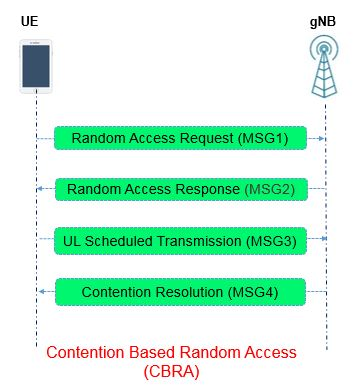
Contention Based Random Access (CBRA): In this case, UE selects a Random Access(RA) preamble from a group of available preambles which are shared with all the UE’s. Due to this, there is a possibility that two UE’s might select the same Random Access preamble and transmit to gNB at the same time which might result in collision or contention (competition for resources) at the gNB. Reference
The gNodeB uses a contention resolution mechanism to handle this type of access request. In this procedure, the result is random and not all Random Access succeeds. CBRA is also known as four-step RACH Procedure.
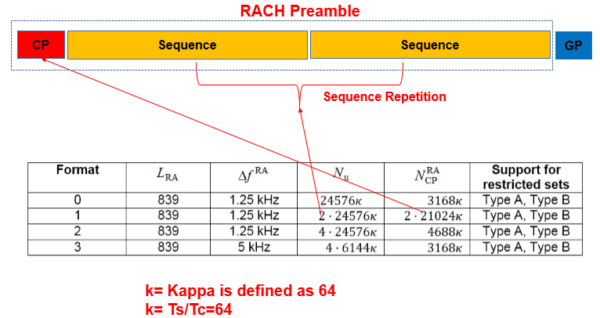
Preamble — It is a signal used to synchronize the transmission timing between two or more systems.
In general, we can say that “someone is about to transmit data”.
Direction: Reference
Step 1: Random Access Preamble Transmission (Msg1)
UE transmits the Preamble to the appropriate beam of gNB.
What does this mean?
UE transmits the request message for UL synchronization through the same beam used for the DL transmission. Reference
Step 2: Random Access Response (RAR) (Msg 2)
Upon receiving a preamble, the gNodeB applies for a TC-RNTI (Temporary Cell Radio Network Temporary Identifier) and schedules the UL and DL resources. Then, the gNodeB sends an RA response over the PDSCH which contains the RA-preamble identifier, timing alignment information, initial uplink grant, and temporary C-RNTI (Cell Radio Network Temporary Identifier). One PDSCH can carry RA Responses to multiple UEs. After the UE sends a preamble, it monitors the PDCCH and waits for an RA response within an RA response window:
If the UE receives a response containing the same RA-preamble identifier as the identifier contained in the transmitted RA preamble, the response is successful. The UE then transmits uplink scheduling information. Else, it fails to verify the response and retries RA after some unsuccessful attempts (10).
Step 3: Scheduled UL Transmission (Msg3)
The UE sends Uplink Scheduling Information such as initial RRC connection setup message, RRC reestablishment request message, RRC Handover messages, etc over the PUSCH.
RRC Setup Request — UEs need to determine which uplink slot will be used for sending the Msg3
Step 4: Contention Resolution (Msg4)
After the UE sends Msg3, a contention resolution timer of 4 ms starts. The gNodeB assists the UE in contention resolution using the C-RNTI on the PDCCH or using the UE Contention Resolution Identity IE (Information element) on the PDSCH.
The UE keeps monitoring the PDCCH before the timer expires and considers the contention resolution successful and stops the timer if either UE obtains the C-RNTI or the temporary C-RNTI over the PDCCH.
If the contention resolution timer expires, the UE performs RA again after some unsuccessful attempts (10).
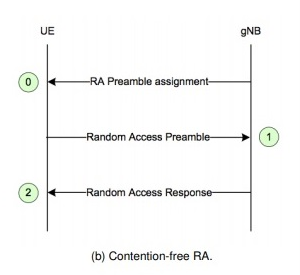
2. Contention Free Random Access (CFRA) — In the case of Contention Free Access Procedure, gNB allocates a dedicated RA preamble to UE which removes the possibility of collision. The dedicated preamble is provided to UE either via RRC signaling or PHY Layer signaling (DCI on the PDCCH).
When dedicated resources are insufficient, the gNodeB instructs UEs to initiate contention-based RA. CFRA is also known as the three-step RACH procedure.
Direction: Reference
Step 1: Random Access Preamble Assignment
The gNodeB allocates an RA preamble to the UE during handovers, NSA networking, etc, and sent it using RRC Msg or DCI.
Step 2: Random Access Preamble Transmission (Msg1)
UE sends the preamble through the same beam used for the DL transmission.
Step 3: Random Access Response (RAR) (Msg2)
The gNodeB sends an RA response in the following scenarios:
Handover — the RA response must contain the timing alignment information and an initial uplink grant.
DL Data Arrival: When downlink data arrives at the gNodeB, the RA response must contain the timing alignment information and RA Preamble IDentifier (RAPID).
NSA networking: When NR cells are added to NSA, the RA response must contain the timing alignment information, and RA Preamble IDentifier (RAPID).
Timing alignment — TimeAlignmentTimer is used to control how long the UE is considered uplink time aligned.
RAPID (Random Access Preamble IDentifier) — The UE picks a random preamble for the RACH procedure to get the uplink synchronization, this preamble is referenced with an ID known as RAPID.